
#50 Building an Anti-Burnout Business and Life as an AuDHD Leader, with Dr Hayley D. Quinn
podcast classroom 5.0 Dec 04, 2025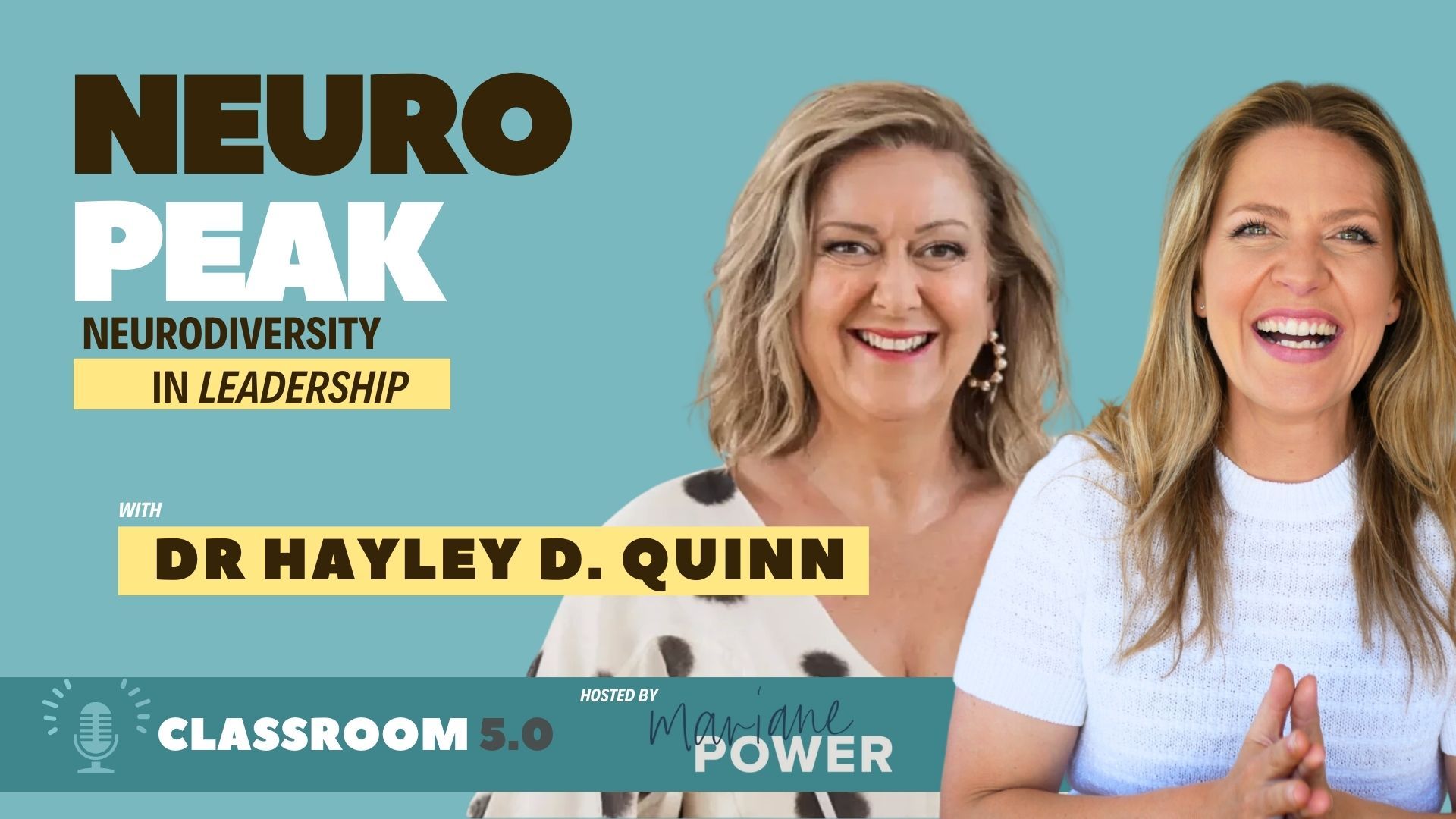
A conversation with Dr Hayley D. Quinn on masking, meltdowns, and building work that doesn't break you
Featuring Episode 50 of the podcast Classroom 5.0 (listen on Spotify here), and announcing the new podcast, Jagged Brilliance: AI, Neurodivergence and the Future of Leadership, launching soon!
Today I'm sitting down with Dr Hayley D. Quinn, a proud Autistic ADHD (AuDHD) woman, former Clinical Psychologist, anti-burnout business coach, host of the podcast Welcome to Self, and author of the forthcoming book From Self-neglect to Self-Compassion (available for pre-order now - get yours here!).
This conversation has been waiting for its moment. Listening back now, with everything shifting in work, AI, and expectations on neurodivergent leaders, it feels exactly right for episode 50 and for this transition point in my own work.
This episode marks the close of Classroom 5.0 for now. But it's not the end.
In 2026, I'll be launching Jagged Brilliance: AI, Neurodivergence and the Future of Leadership, a new podcast where we dig into what it means to be deeply human while creating sustainable work-life design that enables different kinds of difference-makers to thrive.
Watch your inbox for updates. More coming soon.
If you like the sound of this future direction, you're going to love this conversation with Dr Hayley D. Quinn about burnout, breakthroughs, career pivots, and navigating life and work as late-identified neurodivergent women.
Here's what Hayley and I cover in the episode:
1. Burnout Isn't a Badge of Honour (Especially for AuDHD Brains)
If you work in creative, caring, or impact-driven spaces, you don't need statistics to know burnout is everywhere. But here's one anyway:
Research from Never Not Creative found that 70% of people working in Australian creative industries reported burnout in the past 12 months.
Now add late-identified neurodivergence, masking, sensory overload, parenting and perimenopause and you've basically built the perfect storm Hayley describes.
Burnout didn't arrive as a gentle "maybe take a weekend off" whisper for her. It was a full systemic crash that brought with it:
- Significant fatigue that rest didn't touch
- Loss of income, opportunities, and social connection
- Questioning whether her marriage would survive
- The dread of "I don't know if I can keep doing this work"
The Work-In, Not Work-Out Principle
One of the most important distinctions we arrived at in this episode was that while you can absolutely work your way INTO burnout, you cannot work your way OUT of it.
Yet so many of us respond to early warning signs by doing exactly what she shared she did:
- Feeling "not good enough"
- Taking more training
- Reading more articles
- Adding extra clients
- Working harder in session
If you're a neurodivergent founder or leader and this hits close to home, you're very much not alone. Inside Master Your Magic™, we talk about this as over-responsibility dressed up as integrity: "If I just learn more / give more / prove more, then I'll feel safe."
Spoiler: You won't. Not from that place. Rather, as Hayley shares, it's through radical self-acceptance, rest and self-care that you can discover a natural rhythm you can come back to, and build sustainable work-life routines around.
2. The Quiet Cost of Masking & "Being the Chameleon"
Masking, in the context of neurodivergence (especially ADHD and Autism), refers to the conscious or unconscious effort to hide, suppress, or camouflage one’s natural traits, behaviours, or needs in order to appear more “neurotypical.”
It’s a survival strategy shaped by societal expectations and internalised messages over time. Research and lived experience suggest masking is especially prolific among neurodivergent women and AFAB (assigned-female-at-birth) individuals.
Hayley describes herself as "a chameleon" for most of her life : "I'd walk into a room, scan for what was expected, and morph into that. It was slowly killing me."
It can be a useful survival skill in unsafe spaces. But long-term, chronic impression management of this kind, particularly in helping professions and leadership roles, can be a straight line to burnout. and yet, it becomes a default for many high performing neurodivergent people in particular, because it is often praised:
- "You're so professional."
- "You're so adaptable."
- "You're so easy to work with."
When coaching neurodivergent founders and leaders in particular, I call this the performance trap: when your value feels tied to how convincing your "together" self appears, not how resourced your real self actually is. It's one of the core patterns Hayley shared she needed to dismantle in her own self-development work, slowly, gently, and with compassion. Now she shares what she learned not only clinically, but personally, with others.
If you recognise yourself in the chameleon, consider asking:
- Where am I bending myself into shapes that no longer fit?
- Which rooms require a version of me that leaves my body buzzing or my brain wiped for 48 hours after?
- Where might I experiment with bringing 5% more of my actual self into the space, and see what happens?
3. The Dehumanisation of Therapists (And Why It Matters Beyond Therapy)
A significant part of this episode features two ex-clinicians (myself and Hayley!) making sense of a profession we both loved and ultimately stepped away from.
Hayley names something I also experienced but didn't have language for: The dehumanisation of therapists. As we unpacked our journey, we agreed that we were trained as clinicians, explicitly and implicitly, to "leave ourselves at the door." To be:
- Neutral
- Non-disclosing
- Endlessly present for the other
Yet the research is clear: the therapeutic relationship, the actual human connection, is the strongest predictor of positive therapeutic outcomes, across modalities.
Hayley shares a story about a client who told her: "One of the most helpful things about working with you was your humanness, that you reacted when I told you things." Not by making it about her, but by being visibly moved, present and real.
This tension doesn't just live in therapy rooms. It lives:
- In corporate leadership ("don't be too emotional")
- In teaching ("don't show your humanity")
- In entrepreneurial spaces ("don't show the messy middle")
But here's the thing : when we strip all human texture from our roles in the name of "professionalism," we don't just lose warmth, but the capacity and space for trust that is integral for relational development and repair, modelling, and shared humanity.
For neurodivergent clients, staff, students, and founders, that loss is amplified. Many are already scanning every interaction for "is it safe to be me here?" If all they meet is polished neutrality, the answer is often assumed to be 'no'.
4. Burnout vs "I'm Just Tired": How to Tell the Difference
One question I asked Hayley was how she distinguishes burnout from "I'm cooked and need a holiday." Her answer was less DSM-checklist, and more a deeply human audit.
Instead of only googling symptoms (though you can do that), notice:
- What am I doing more of lately?
- What am I doing less of?
- Are those changes helpful or harmful?
- What would my support crew say if I asked, "How do I seem at the moment?"
And it's important to know those signs look different for everybody. For Hayley's PhD office mate, burnout showed up as everything becoming a joke, a constant humour to avoid facing how bad things felt. That's not a symptom you'll find in a manual, but it was absolutely a red flag.
For Hayley, it was the old "I'm not good enough / I'm not smart enough" stories flaring, and then overworking to compensate.
For many of my clients, burnout looks like:
- Losing access to joy, not just energy
- Struggling to feel anything about work, good or bad
- Needing more and more stimulation (coffee, noise, urgency) just to feel "normal"
5. The Three Circles, Threat-Based Drive & AI Panic
If you've heard me talk about AI and neurodivergent leadership lately, you know I keep returning to the question of how we navigate the pace of change with intentional design that honours our energy.
In this episode, we explored how the changes with AI can trigger uncertainty, which in turn can trigger threat. with that cycle, like many others that follow the uncertainty and threat signals, humans who perceive themselves to be under-resourced can find themselves sprinting into threat-based hustle.
Hayley describes this beautifully through Compassion Focused Therapy's three-circle model:
- Threat system – scans for danger
- Drive system – pushes for achievement, acquisition, status
- Soothing system – gives us safety, contentment, connection
Most of us in Western, high-achievement culture have a very over-exercised drive system and a very under-practiced soothing system.
When AI enters the chat and the "will I still be relevant?" spiral kicks off, we might bolt straight into drive:
- "If ChatGPT can write 200 posts, I need 400."
- "If AI can answer client questions, I need to prove I'm more valuable than the robot."
That's threat-based drive, not purpose-driven work.
The Move Toward Soothing
The move Hayley modelled, and that I'm committed to practicing in my own work, looks more like:
- Notice: "Ah, hello, threat."
- Soothe first: Hand on heart, breath, body, environment.
- Then ask: "What only I can do here, as a human?"
- And: "How can I use AI to support my nervous system and values, not to outrun them?"
If you're curious about this, we're going to unpacking practices like these more deeply in my 2026 workshops on AI, neurodivergence, and the future of leadership, and it will be a core thread in the new Jagged Brilliance podcast. Be sure to subscribe to the newsletter to stay in the loop.
6. Self-Trust as a Business Strategy (Not a Luxury)
Underneath all of this, burnout, masking, AI, boundaries, Hayley returned to one recurring theme which was the importance of radical self-trust. A lived, sometimes shaky and often messy relationship with self that sounds more like:
- "I can trust my body when it says no."
- "I can trust my brain to deliver when something truly matters, and also trust it when it needs to stop."
- "I can trust that stepping away from a system harming me is not failure; it's integrity."
What Self-Trust Looks Like in Practice
For Hayley, that looked like:
- Leaving clinical practice and her registration
- Naming burnout out loud
- Choosing anti-hustle business design
- Writing a book that demanded she live its title while creating it.
You can pre-order Hayley's book, From Self-Neglect to Self-Compassion here
If this episode stirred something in you, the chameleon, the exhausted high-achiever, the quietly terrified founder watching AI sprint ahead, here are some gentle next steps:
🎧 Listen to the Full Conversation
Episode 50 of Classroom 5.0 with Dr Hayley D. Quinn is available wherever you get your podcasts. Find it on Apple Podcasts here
📖 Pre-Order Hayley's Book
From Self-neglect to Self-Compassion is available for pre-order via Hayley's site or your local online bookseller.
🔗 Connect with Dr Hayley D. Quinn
Find Hayley on Instagram or LinkedIn at @drhayleydquinn, and through her website here
💫 Explore Neuroinclusive Work-Life Design
If you're a neurodivergent leader ready to build a business that works with your brain, not against it, a reminder that Master Your Magic, my leadership development container for high-performing neurodivergent professionals opens its doors for enrolment soon, with our cohort starting February 20th, 2026! Register your interest here
📬 Stay Connected for What's Next
This episode marks the close of Classroom 5.0, but it's not the end, it's a pivot. Thank you for being a listener of Classroom 5.0, for being here and inviting me into your ears, wherever they might find themselves, and for joining this amazing journey.
When I first started the podcast, I imagined it as a place where we'd explore learning, creativity, identity, and what it meant to grow into the people, but also the world that we're becoming. And honestly, it has grown in ways that I actually never could have predicted.
Every single guest and every single piece of feedback that you've sent me; every email you've written, every message you've left, the people that I've bumped into at trainings and said, 'wow, I listened to your podcast' has blown my mind.
This podcast has held space for conversations that I've personally experienced to be deeply moving and inspiring. We've explored our inner worlds, our differences, our brilliance and vulnerabilities across generations. And most importantly, we've imagine solutions to create positive changes to the systems that we rely on, to help us navigate this wild and whacky ride called life.
Classroom 5.0 has been such a meaningful home and container for these conversations and our collective hope for a brighter future. I truly can't imagine closing the doors on it forever, and imagine it just might have another chapter to unfold when the time is right.
It will remain as it is, where you always find it. Just put 'Classroom 5.0' into any search engine and there it will be.
For now, it's time to evolve. So whether you found the show last month or whether you've been with us from episode one, thank you for being a part of this community. Your listening, your feedback, and the conversations that emerged in the spaces between have shaped this next step. Truly, I mean that.
Here's to "Classroom 5.0: the future of learning, work and leadership" and the Jagged Brilliance that it's evolving. I'll see you there, in the very first episode, coming soon.
